Page one
The answer is on page one. No. And it has not changed once in the eighty-six years people have been asking it.
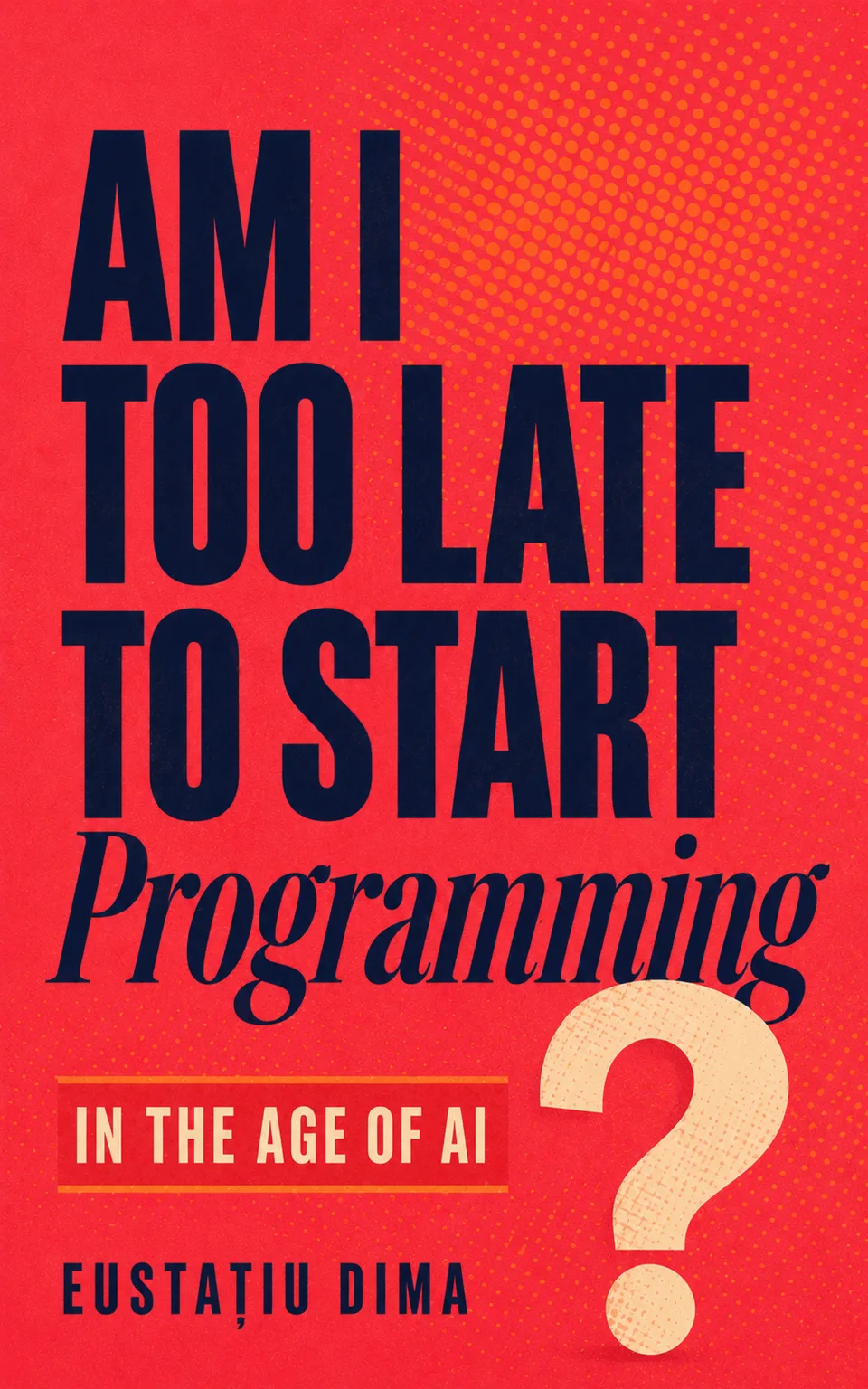
Am I Too Late to Start Programming? In the Age of AI
The question
The feeling is not information about the moment
There is a specific dread in this work and almost nothing is written about it honestly. It is not the fear of being fired. It is the certainty of being behind. There is always something you should already know, and there is always someone younger who knows it.
I have had that feeling since I was nine. I had it while I was winning things. That is the part that took me twenty years to understand: it never went away when I got better, which means it was never about how good I was.
The person watching FORTRAN arrive in 1957 felt it. So did the one who had learned on punched cards and was suddenly expected to think in C. So did everyone who watched open source arrive, and then the answer to every question appearing on a website for free. Every one of them believed the ground had moved under them specifically. None of them were right. All of them felt it.
None of them were right. All of them felt it.
The structure
Seven eras, each carried by one real person
Each life is shown at the moment the ground moved: what the person had built themselves out of, what the new thing took away, what they did next, and whether they were right about what they had lost. Where the record shows one of them handling it badly, the book shows that.
-
Nobody knew how
1940 to 1946Programming did not exist as a thing to be taught. Six women were handed a block diagram and told to make the machine compute trajectories, with no manual, no language and nobody to ask, because nobody knew.
-
The machine writes the code
1954 to 1957The first time the labour was automated away, promised in writing by the people building it. The thing it destroyed turned out not to be the thing that mattered.
-
No second run
1963 to 1969Software woven into copper wire, unchangeable once made, with a man life riding on it. How do you learn when being wrong is not recoverable?
-
Read the source
1971 to 1986A generation taught itself by reading the machine it was standing on, from a commentary that was never supposed to be published.
-
One character wrong
1975 to 1984The first people who learned alone, as children, from a manual in a box, with nobody to ask and one character standing between working and not.
-
The answer already exists
1991 to 2015The answer to almost every question became free and instant. What that gave, and what it quietly took, are both measurable, and the measurements do not agree with the folklore.
-
The number that lost its decimal
2021 to nowThe machine writes it, checks it, and tells you it is right. A backtest claimed two thousand percent a year. It took a hundred and one passes to find the leak.
The argument
And then the part that is harder to say
By the ordinary reading this is the worst moment in the history of the field to be starting out. The entry level work is the work the machine does best. Every reason to feel late is present at once and louder than it has ever been.
It is the best time, and not by a small margin. For the whole history of this profession the thing that separated people was access to the loop: how fast you could try something, be wrong, find out why, and go again. That loop was gated by machine time, by a compiler you waited overnight for, by whether anyone near you already knew. Every one of those gates is now open, at conversational speed, for the price of a subscription.
If you use it well is not a hedge in that sentence. It is the load. The same tool that closes the loop can close your mind, and the research says so plainly. So the last part of the book defines well precisely enough to be checked.
The payload
What you leave with
Two or three rules accumulate per chapter into one cumulative playbook. It fits on a couple of pages by the end, and every line on it has a person and a date behind it. Not advice. A practice, with a source.
- How people actually learned in each era, from the record rather than the folklore
- How long it really took them to become competent, where a number exists
- What transfers to somebody starting today, and what does not

I felt late the entire time.
The method
How it is being made
Every historical claim in this book is sourced to two genuinely independent records, at least one of them primary or scholarly, quoted verbatim from the original with a locator, and checked again in a cold second pass by someone who did not write the sentence. No record, no sentence. The corpus stands at 622 records and ships publicly with the book.
It is being written openly with AI, and the method is part of the argument rather than a disclosure buried at the back. Where the record shows one of these people handling the moment badly, the book shows that. Where the research cuts against the tools, that is in the book and not in a footnote.
Where it stands
Eight chapters, about 43,000 words, drafted and in verification. Not yet published and not yet on sale.